
Call us now
08071931711

 Amule-drawn streetcaratLafayette SquarealongSt. Charles Avenuein New Orleans in the early 1890s. The front apron of the streetcar displays an advertisement for a performance ofTrovatore!at theFrench Opera House.
Bus advertising descends from similar methods used onstreetcarsin the early 20th century.[citation needed]
Adverts are placed inbus shelters. These can be static posters, or back illuminated displays, or rolling displays allowing many messages on one shelter. Technology has also been used to createinteractiveadverts.
Adverts may also be installed on associated street furniture such as the backs ofbenchesat stops. Sized at approximately 2.5 by 6.5 feet, bus bench ads tend to be cheaper per unit than other forms of outdoor mass advertising.[1]
Often, the paperbus ticketis used as an advertising space. The ticket rolls for theticket machinesare pre-printed on the rear with a particular companys advert.
A common location for adverts is inside the bus. Adverts are attached to the corners between the walls and ceiling overhead to catch the eye of passengers, in the same manner as used inrapid transitsystems.
Increasingly, companies are using interiortelevisionsystems to advertise. The most common technology is the LCD-TFT systems in different resolutions: 18.5" (also side-by-side panels 18.5" + 18.5"), 21.5" and stretched monitors in 29.4".
The LCD-TFT were originally installed to show route information to passengers (next-stop, path, maps, intersection with other routes etc.), then additional public information (messages from bus company, the Public Administration, etc.) and entertainment, which is known with the neologisminfotainment. It common to use this space for both public information and advertising, providing both a public service but also a regular income for the different players involved in the public transport.
 A bus with a side panel advert fitted in special guides
 ABEST Buswith advertisements on its body. The bus is supplied free of cost in exchange for advertising rights.[2]
 A bus in Singapore with an advertisement forAmazon, with 2D billboards and 3D boxes on the roof of the bus.
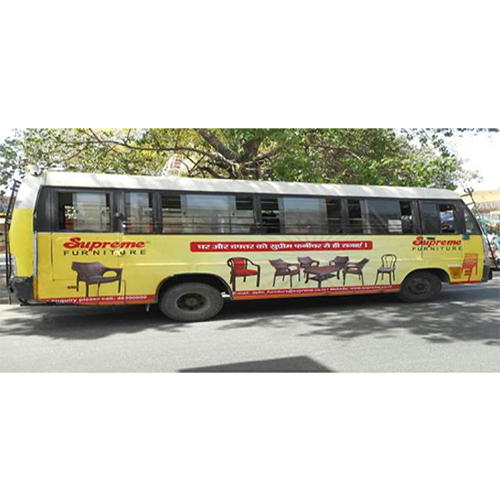
Adverts are often placed as basic rectangular motifs on the side or front of a bus. These may be applied directly to the bus. Additionally, adverts may be printed on placards known as boards, which are slotted into special guide fittings attached to the side of the bus.
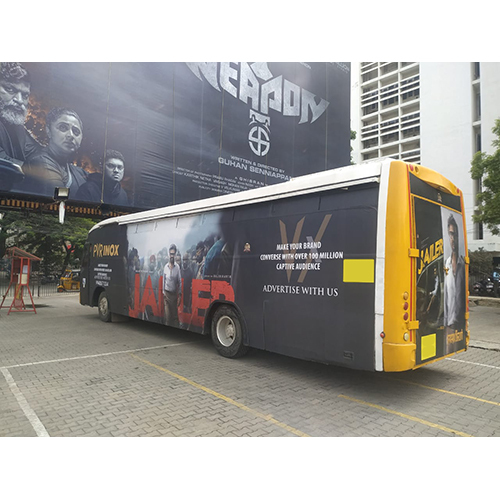
Occasionally, the entire surface of a bus is turned into an advertisement. This can be a whole side or rear of a bus, or a scheme applied to the entire exterior, known as an all-over advert bus.
A variety of formats are available to marketeers, although the most commonly used media formats are:
There are different options available to these formats in London because of the citys iconicdouble-decker buses.
Advertisers looking to promote a message can also make use of these formats which include:
Depending on the size of the bus and its location, further creative can consist of:
In some jurisdictions, such asSingapore, advertising agencies offer advertisements on 2D billboards which extend upwards from the bus, as well as 3D concept advertising on the roof of buses.[3]
 Vinyl decals allowing use of windows, on a side and rear advert for alcohol on a Berlin bus
Some panel and full side and all-over adverts were traditionallypaintedon if the length of application warranted it. This would require a reasonable longevity and cost implication for advertisers, due to the requirement to take buses out of service to apply and remove paint schemes. Frequently changed panel adverts would use replaceable boards.
With the advent of adhesive vinyl technologies, this allowed adverts to be rapidly applied and removed over the top of the buses exterior paint asdecals, reducing the cost and time.
The invention ofsee-through graphics, most commonly applied as a self-adhesive perforated window film, allowed the creation of more elaborate designs that could be applied over windows (although for safety reasons not the front window), moving away from the traditional square box design approach to adverts.[citation needed]
With the advent of partially transparent window coverage techniques, all over adverts have been applied as a fullvehicle advertising wrapwindows and all. The transition fromscreen printingtodigital printinghas seen an increase in the color range and complexity of advert designs.
The latest bus advertising campaign by Adidas for the Brazil World Cup 2014 made use of full wrap and window coverage techniques.[4]Transport for London launched the new formats as part of its year of the bus celebrations, which commemorates the 60th anniversary of the Routemaster bus and the 100th anniversary of the first mass-produced motorbus.[5]
.jpg) A campaign bus
A campaign busIn addition topublic transportbuses, all-over advert buses are often privately hired specifically for a special promotional use, such as apolitical campaignor specific product promotions. These will often make use ofopen top busesto allow the interaction of the campaigners/promoters with the public.
InNorway, the use of wrap advertising on buses was prohibited by the road authorities. The reason behind the ban was that in an emergency the windows might need to serve as anemergency exit, and that the advertising would make the window harder to break with theemergency hammer.Gaia Trafikkargued against the ban, pointing out that their tests showed that the thin wrap had no impact on the breakability of the window, but did remove the advertising which covered the windows.[6]

Price:


 Send Inquiry

 Send Inquiry
 Send Inquiry
 Send SMS